
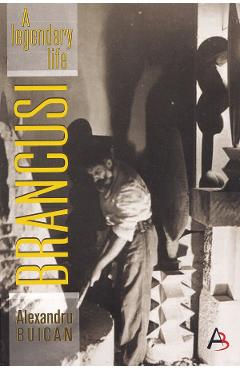
Foreword Why isn’t there a biography of Brancusi yet? We have asked ourselves this question seventeen years ago and find it as bewildered as it referred to a sculptor of whom it was said: „Next to Shakespeare and Beethoven, there is yet a god: and that is the Romanian Constantin Brancusi”; or „The history of sculpture, in Europe, measures only three landmarks: Phidias-Michelangelo-Brancusi”.
And soon this bewilderment turned to frustration. We had to admit, then, that such a biographical attempt is not in the least easy.
First of all, the one who dares approach such a task should have access to several cultures: Romanian, French, and, although Brancusi lived almost half a century in France, especially American. For most of his life, the sculptor was in a position to live physically in France, but to be financially dependent on his American patrons.
And not only that. His recognition came in 1913 at the famous Armory Show in New York.
And the extraordinary celebrity that followed was brought to him by the even more famous „Bird trial”, known as Brancusi v. United States, which also took place in the US.
The enthusiasm with which Brancusi was embraced by the Americans was incredible. Therefore, a very large number of the most important names of American culture wrote about him, leaving to posterity a vast body of memories outside of which Constantin Brancusi’s biography cannot be written.
Naturally, the attempt should have come from the Romanians, whose interest in such an illustrious representative born amongst them is somewhat greater. But the political context surrounding Romania after the Second World War couldn’t have favored the appearance of a Brancusi biographer.
The Iron Curtain between Romania and those cultures where Brancusi became renowned cut back the number of people who were allowed to travel and made research almost impossible. And the ideological attacks that transformed the famous sculptor of The Bird, for decades, following his death, into an outcast artist, made the mission extremely difficult from the start.
For the researchers outside Romania, the same factors acted in the opposite direction. To them, those formation years and especially that intimate, physical, and psychical environment Brancusi came out of remained impenetrable.
And, foremost, in addition to the many historical difficulties came the greatest difficulty of all: the uniqueness of the subject itself. From the very beginning, we must state that the real motivation behind this biographical attempt lies within the interest that Brancusi’s work has stirred within us from the very early times of our lives.
The spectacle of Brancusi’s art has been a revelation to us, thus imposing itself as truth from the first impact it had on us. (After all, we are writing Brancusi’s biography half a century after his disappearance, because he is the one who created The Birds, The Kiss, The Column, and his portraits).
But revelation doesn’t imply understanding, and upon trying to clarify what the truth of his art resides in, we find ourselves confronted with difficulties. What appears to us as particularly astonishing is the wide variety of exegetic opinions, a variety which is a mere testimony to the fact that we are facing a grand creation.
As we believe that his work is best explained by the biographical incident („It is not hard to do my work, Brancusi used to say, it is hard to put myself in the situation of doing it”), we have first tried to understand that ensemble of soul and thought this grand creation came out of. And then the variety of interpretations of the man appeared to us even more astonishing than those of his work.
To the one who reads brancusian literature, it is immediately obvious that Brancusi’s personality, through its originality, not to say its „exoticness”, appeared to the critics as hard to scrutinize and assemble in one unifying formula. The sculptor’s personality has been explained in various manners, the diverse „formulas” given are the most contradictory.
He has been successively talked about as a Platonist, a peasant, a saint, an eccentric character, and many more. We have read these „formulas” with great interest (our conscience obliged us, during the conceiving of this book, to read as much as possible of what had been written about him), and thus we came upon some very interesting interpretations.
But as each of these interpretations had a measure of truth in it, so it appeared to us as having a measure of falseness. We have consequently come across a „Brancusi mystery”.
It has then clearly imposed on us the truth that unraveling the „Brancusi mystery” cannot be done in pieces. Therefore, we have strengthened our belief that the vast variety of suggested „solutions”, as well as the disconcerted observable behind these attempts, is to a certain degree the consequence of the absence of the biography.
And it is obvious that almost everyone who wrote about Brancusi’s works had felt this absence, for they tried to bring to the surface, to some extent, the sculptor’s existence, giving either various portraits or more or less precise chronologies. No more than that.
Moreover, writing a biography isn’t a task for anyone, but a task for the one who heard the inner call of bringing back to life Brancusi, the man. Therefore the biography did not appear.
The writing of this book raised many problems of which I will mention only a few. The reader wants to know from the very beginning which type of biography ours is.
It is usually believed that there are two main biographical schools. The first is the „erudite” one, consisting of a series of dates discussed over thoroughly by the authors, usually professors afraid of being accused of „vulgarization” or „popularization”.
The other one is the „artistic” one, whose representatives want the „hero” to live throughout the pages of the book. These authors are afraid that their work will remain otherwise unknown to the general public.
The two schools appear to legitimately exclude one another. On one hand, the „erudite” biographers want to discredit the „artistic” biographies as unscientific, trying to raise in the reader’s mind the doubt regarding the thoroughness of the information, accrediting the idea that talent is opposed to academic rigor.
In a way, they imply that artistically presenting even the strictest erudition would lower the biography in the abominable domain of „fictionalized lives”. (We will not defend the cause of the fictionalized „biographies”.
Enough has been written against these unworthy inventions for us to insist on. Let us only say that, in our case, such works have not aided us even for orientation, let alone documentation.) On their behalf, the authors of the artistic biographies accuse the „erudite” school adepts of lacking the talent to evoke.
The accusation, although justified at times, doesn’t explain everything either. We believe that this „bickering” doesn’t reside in a difference of method but a difference of temperament.
Accessibility is true to a significant extent a matter of exposing the material. Eliminating from the text the discussion of the sources, referencing them as footnotes, and using the means of composition is sufficient to make even the most „academic” of works accessible to the general public.
Why, though, do the „erudite” school adepts not cross this line? The real problem does not consist of the method of exposition.
Most of the time, in their efforts to be „academic”, by presenting their indiscreet manner of searching through sources, these „erudite” school adepts divulge their intellectual intimidation before the biography. As accused, they end up stopping life (which is the very essence of the biographical genre) from entering their books.
Just as false is the doubt shown by the „erudite” school adepts towards the documentary thoroughness of artistic biography, for nothing hinders the latter to be based on the same documents as the „erudite” biography. This contradiction between „erudite” biography and „artistic” biography stroke us as being only an apparent one.
Artistic biography is, compared to the „erudite” one, not different, but „more than less”. Lacking the talent to evoke, or rather intimidated when confronted with the subject, the former stopped too soon.
The true difference between these two manners (which are, in fact, only different stages) of biography is found within a spiritual dimension of the author who does or does not see „deep”, in relief, tridimensionally. A biographical writer must have, just as the biography’s reader whom he wants to reach, a passion for life.
But, most of the time, the latter drops the book dissatisfied. Out of the „thorough” biography, he has just read he may extract many a date whose preciseness he had been convinced not to doubt, from the discussion of the sources.
But something seems to be missing from the book. And most of the time what’s missing is life.
Wanting to unravel the „Brancusi mystery” we have foremost rejected an a priori cipher and, in order not to reach an arbitrary solution, we have always heeded the documents. We have thus obliged ourselves to an erudition work.
But we understood that we were writing this biography at a time when the written word lost its predominance in front of images (film, television) and we changed the optics. We highly prize the notion of „presence” and consequently, we have tried to bring Brancusi back to life by detaching from the multitude of documents all those „flashes” in which the man is raised above void by the written memory of one or another of his contemporaries.
So we have given the greatest attention to those evocations which make their authors eyewitnesses. Evoking a Brancusi and Modigliani’s escapade to Hale to eat onion soup, ended for Brancusi, because of drunkenness, at the police station, maybe regarded by the „erudite” as an impiety, but just as the arid chronology is the skeleton of the biography, so are those moments its flesh.
If we also managed to quantify the abstract chronology of documents in epic categories, corresponding to the incidents of Brancusi’s biography, superimposed on the public events of his lifetime („War”, „Americans in Paris”), another purpose of this book was achieved. Another matter appeared as important.
To draw out of the past and bring back to the present the long and painful, but also full of joy artist’s process of creation, another task had to be undertaken, that of dating the works. The previous chronologies, at a more thorough analysis, have revealed many an error.
The dates are controversial and we have consequently decided to take it all from the beginning and put together a chronology by confronting all sorts of documents (especially photographic ones), thus solving an enormous jigsaw. A detective’s work.
Exciting, but not in the least easy. A common thing for the biographer as well is the fact that one’s existence cannot be understood outside its time and place.
Brancusi, one of the heroes Foreword 13 of modern art, lived for fiftythree years in Montparnasse, and Montparnasse was the place where almost everything related to this modern art came into being. Thus, nothing is more natural than the attempt to get closer to Brancusi through the indirect manner-circumstantial we can call it-of evoking the time and place where his life unfolds.
And, in his case, this evocation appears even more essential. Here, a reason for bewilderment is the fact that, in that incredible Montparnasse, where eccentricity was sought out no matter the cost, Brancusi was regarded as an authentic eccentric character.
And, after a while, to whoever begins to slowly understand the essence of the artist’s character; it becomes clear that his eccentricity came from his radical way of refusing any eccentricity. The principle of evoking the environment, a justified one to those who adhere to it, is all the more valid to those who define themselves by rejecting it.
That is why in our priorities’ order evoking the epoch is at the same level as evoking the man. In most biographies, the accent falls till monotony on the main „hero”; the other characters, those playing an active part in the „hero’s” life, remain only abstract ones.
Consequently, the epoch cannot be called forth, for this implies the collaboration of a great number of people. We wanted to step over this drawback and thus evoked as many times as necessary the lives of those revolving around the sculptor.
Brancusi’s presence, however episodic, at the banquet held by Picasso in honor of Rousseau-„Le Douanier”; the presence, at the same cafe table, of Brancusi, Picasso, and Matisse at a Dadaist meeting, meeting degenerated in a monstrous scandal, all these give substance to abstract things, place us in the middle of events, but most of all place our hero within his times. These human interactions explain the climate of ideas.
Not mentioning a visit Lehmbruck paid to Brancusi at the time when the latter would present his Prayer at the Saloon, would mean not giving a true picture of the epoch (the lines of The Prayer would later be obsessively found in the German’s creation to whom the Romanian’s sculpture provoked a „revelation” and gave the very key to his subsequent artistic vision) and even compromising the attempt of evoking Brancusi himself. Therefore, we have bound ourselves to read an impressive number of books about the times of the first half of the last century’s Paris.
On one hand, synthesis books about the epoch, and on the other, biographies of those „characters” who gave substance to that epoch, also synthesis works, but let us call them onedimensional works. The exposition of the material is chronological.
Nevertheless, we have alternated the chronological method with the essayistic one. The chronological method pushed too far would have resulted in an absurdity.
Much of the information which cannot be dated would have been left out, and others, dated, would have broken the narration. An eloquent example is the visits to Brancusi’s studio, extremely numerous and some even very significant.
These have been approached with the essayistic method. Otherwise, we should have broken the narration whenever the studio door in Impasse Ronsin opened.
We called our book „a biography” and not, pretentiously, „A life of Brancusi”. Will other biographies be written?
No doubt. Brancusi has posterity on his side.
Others, more competent and gifted, will fill the gaps left by this first attempt. But, for the moment, Brancusi needed to be seen (not commented on).
– Friday, March 10, 2023, Memphis, TN

Brancusi, a Legendary Life
Detalii:
Foreword Why isn’t there a biography of Brancusi yet? We have asked ourselves this question seventeen years ago and find it as bewildered as it referred to a sculptor of whom it was said: „Next…
177.6
LEI
In Stoc
Anul aparitiei:
2023
ISBN:
9786069577516
Recenzii
5/5
Descriere
de
Ar putea să îți placă și…

Editura
Pret:
51.81 LEI-
-
-
-
De
Editura
Pret:
62.38 LEI -
-
-
-
Editura
Pret:
120.52 LEI -
-
-




de